Victorian land market continues to attract a diverse range of buyers
The Victorian land market continues to attract a broad mix of buyers, each shaped by distinct motivations and prevailing market conditions.
According to Red23 Buyer Surveys, first home buyers remain active, although investors are now more prevalent. In 2025, 21% of buyers were renting at the time of purchase, and just 2% were living with parents — both lower than in 2022, when 25% were renters, 8% lived with parents, and 11% were in group households. Owner-occupiers have steadily declined, falling from 56% of buyers in 2022 to 37% in 2025 as market confidence softened.
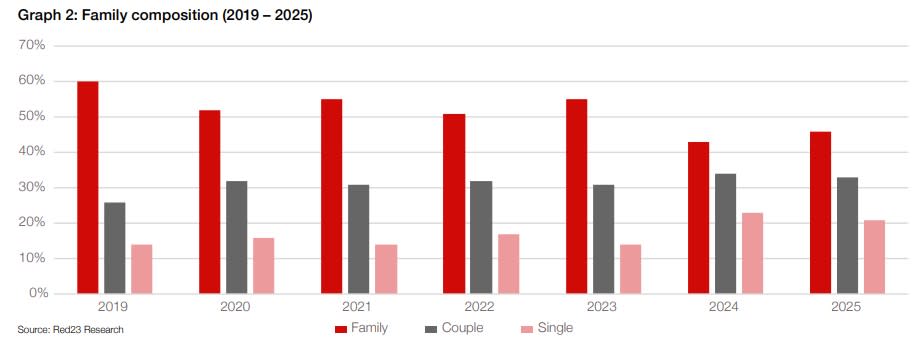
Household profiles have also shifted, with families accounting for 46% of purchases, couples 33%, and singles 21%, down from 2019 when families comprised 59% of buyers.

 Furthermore, Red23 surveys show that 67% of buyers intend to build a single-storey home, with most new dwellings under 25 squares, while 33% plan to build double-storey homes.
The Metro Melbourne median land price rose slightly to $416,000 in August 2025, up 0.48% month-on-month and 0.73% annually. Price movements varied across municipalities, with Hume recording the strongest monthly increase (+3.87%), lifting its median to $442,500, although its median land size fell. Modest gains were also seen in Cardinia (+0.25%) and Melton (+0.50%), while Mitchell declined by -1.43% month-on-month, even as its median land size increased from 477sqm in July.
Furthermore, Red23 surveys show that 67% of buyers intend to build a single-storey home, with most new dwellings under 25 squares, while 33% plan to build double-storey homes.
The Metro Melbourne median land price rose slightly to $416,000 in August 2025, up 0.48% month-on-month and 0.73% annually. Price movements varied across municipalities, with Hume recording the strongest monthly increase (+3.87%), lifting its median to $442,500, although its median land size fell. Modest gains were also seen in Cardinia (+0.25%) and Melton (+0.50%), while Mitchell declined by -1.43% month-on-month, even as its median land size increased from 477sqm in July.
- First Home Buyers (FHBs): Representing 33% of sales in 2025 (down from 46% in 2019), first home buyers continue to focus on smaller, affordable lots in growth corridors such as Wyndham, Casey, and Melton. Incentives including $20,000–$40,000 rebates and the First Home Buyer Grant remain pivotal in driving this demand.
- Investors: Investor participation has increased, accounting for 48% of buyers in 2025 compared to 40% in 2022. Many see value in land prices and the opportunity to build new homes in estates with upcoming or established amenities.
- Relocators / Upgraders: This group, largely families seeking a lifestyle change, made up 11% of sales in 2025 — the lowest share in five years. Historically stronger in 2021 and 2023 (27%), they are being constrained by lower prices in their current homes and may be waiting for values to rise to increase their equity.
- Downsizers: A smaller but consistent segment, downsizers accounted for 8% of buyers in 2025, a level that has remained steady in recent years. Their preference continues to be for compact, low-maintenance titled lots or townhouse sites close to amenities.
Furthermore, Red23 surveys show that 67% of buyers intend to build a single-storey home, with most new dwellings under 25 squares, while 33% plan to build double-storey homes.
The Metro Melbourne median land price rose slightly to $416,000 in August 2025, up 0.48% month-on-month and 0.73% annually. Price movements varied across municipalities, with Hume recording the strongest monthly increase (+3.87%), lifting its median to $442,500, although its median land size fell. Modest gains were also seen in Cardinia (+0.25%) and Melton (+0.50%), while Mitchell declined by -1.43% month-on-month, even as its median land size increased from 477sqm in July.
Joel Robinson
Joel Robinson is the Editor in Chief at iBuildNew, where he leads the editorial team and oversees the country's most comprehensive news coverage dedicated to the new home building industry. With more than a decade of experience in residential real estate journalism, Joel brings deep insight into Australia's evolving home building and construction landscape.