Where Are the Best Opportunities to Buy Land in Victoria Right Now?
A slowdown in Victoria’s new land market is creating potential opportunities for homebuyers, with fewer purchasers competing for lots, longer selling periods and developers increasingly using incentives to secure sales.
New research from property advisory group RPM has revealed residential land sales across Victoria’s major growth corridors fell 46 per cent annually in the September quarter of 2026, with every region recording fewer sales than the previous quarter.
Despite the slowdown, Melbourne’s median lot price increased four per cent to $393,000, suggesting buyers aren’t necessarily finding cheaper land, but may be entering a market where they have greater choice and more room to negotiate.
RPM’s latest Victorian Greenfield Market Report found 3,056 lots were sold across Melbourne and regional Victoria during the quarter, down 36 per cent from Q2 and 46 per cent from the same period last year.
The slowdown follows five interest rate increases in 2026, which have taken the Reserve Bank’s cash rate to 4.85 per cent and reduced borrowing capacity, particularly among first-home buyers.
However, the figures also reveal significant differences between individual growth corridors, with some markets taking considerably longer to sell available land, others offering more affordable entry prices, and several facing a growing imbalance between new supply and buyer demand.
For buyers planning to build a new home, understanding those differences could be the key to finding value.
Where are the best opportunities to buy land in Victoria?
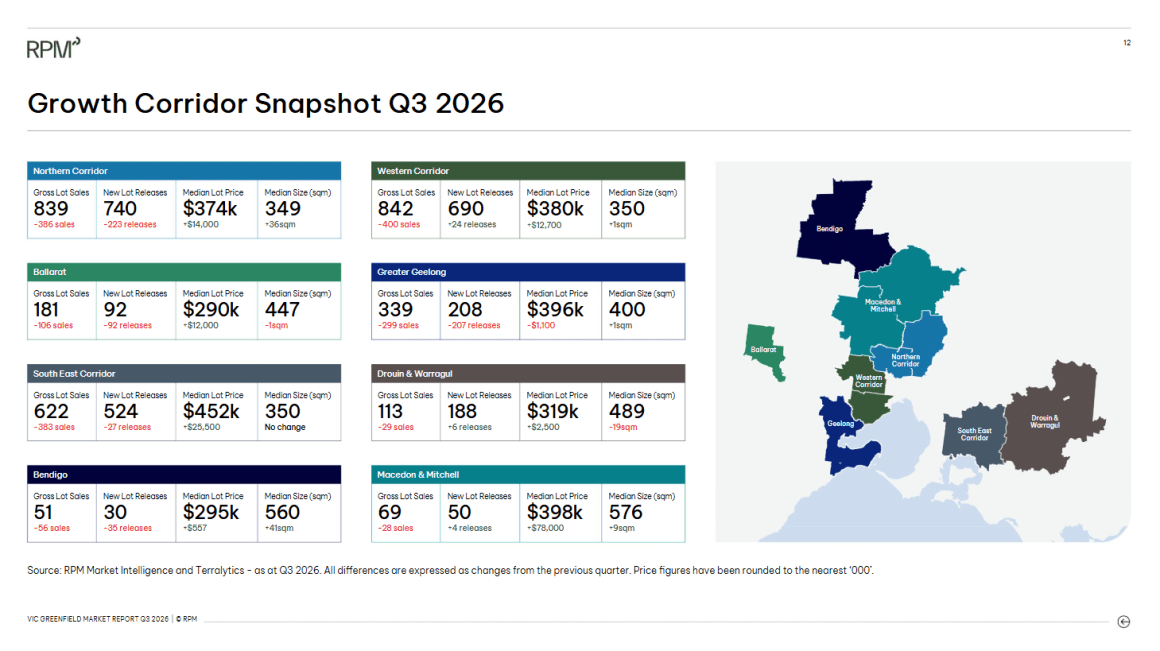
RPM’s research covers eight major metropolitan and regional growth corridors, with median land prices ranging from $290,000 in Ballarat to $452,000 in Melbourne’s south-east.
Source: RPM Victorian Greenfield Market Report, Q3 2026. Prices represent median vacant residential lot prices, before any applicable rebates or incentives.
While sales declined in every region, the numbers suggest buyers could find different opportunities depending on their budget, preferred location and readiness to build.
Melbourne’s west stands out for its longer selling periods and rising stock returns, while the north offers the lowest median land price of Melbourne’s three metropolitan growth corridors.
Ballarat remains the most affordable regional market covered by RPM, while Drouin and Warragul are showing signs of increasing competition between developers as new releases outpace sales.
Melbourne’s west: More time to compare and negotiate
Melbourne’s western growth corridor could offer some of the strongest opportunities for buyers prepared to compare available land across different estates.
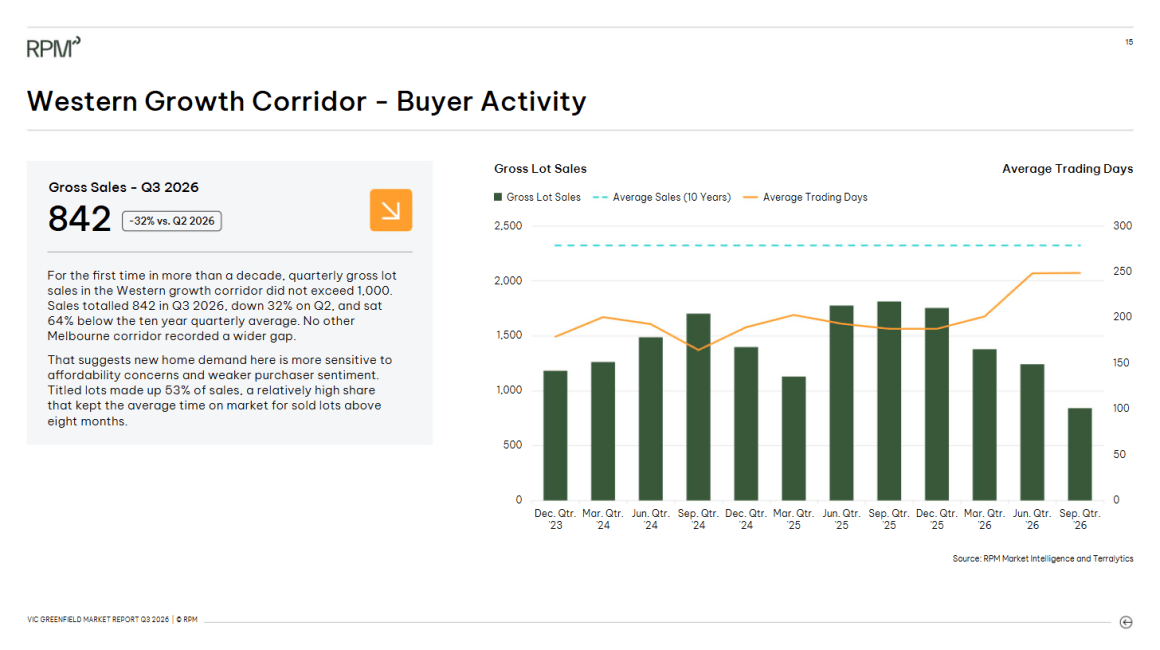
The region recorded 842 lot sales during Q3, down 32 per cent from the previous quarter and 64 per cent below its 10-year quarterly average.
It was the first time in more than a decade that quarterly sales had fallen below 1,000 lots.
Despite the decline, developers released 690 new lots during the quarter, an increase of four per cent from Q2.
Another 222 lots returned to the market, up 19 per cent, as higher interest rates increased settlement risks for purchasers who had previously committed to buying.
The combination of slower sales and returning stock has pushed the average time taken to sell lots to 249 days, or more than eight months.
That is considerably longer than the other metropolitan growth corridors.
The median lot price in Melbourne’s west increased 3.5 per cent to $380,000, although RPM noted that rebates and discounts on titled lots mean the effective price paid by some buyers may be lower.
For buyers looking around Tarneit, Truganina, Rockbank, Wyndham Vale and the broader western growth corridor, the longer selling periods could provide opportunities to negotiate with developers, particularly on lots that are already titled and ready to build on.
RPM’s suburb-level research also shows considerable variation in land prices.
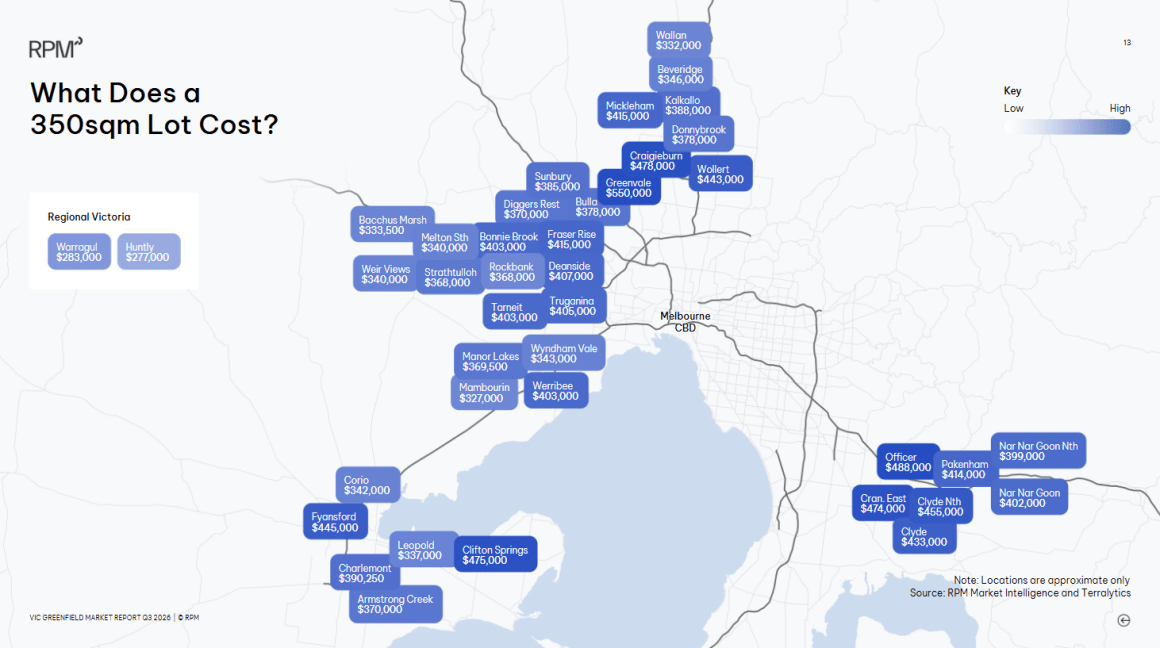
A 350 sqm lot was priced at approximately $327,000 in Mambourin, $340,000 in Weir Views, $368,000 in Rockbank and $403,000 in Tarneit.
Those differences demonstrate why comparing estates and individual lots can be just as important as choosing the right suburb.
Melbourne’s north: The most affordable metropolitan growth corridor
For buyers who want to remain within Melbourne’s metropolitan growth areas, the northern corridor offers the lowest median land price of the three major markets.
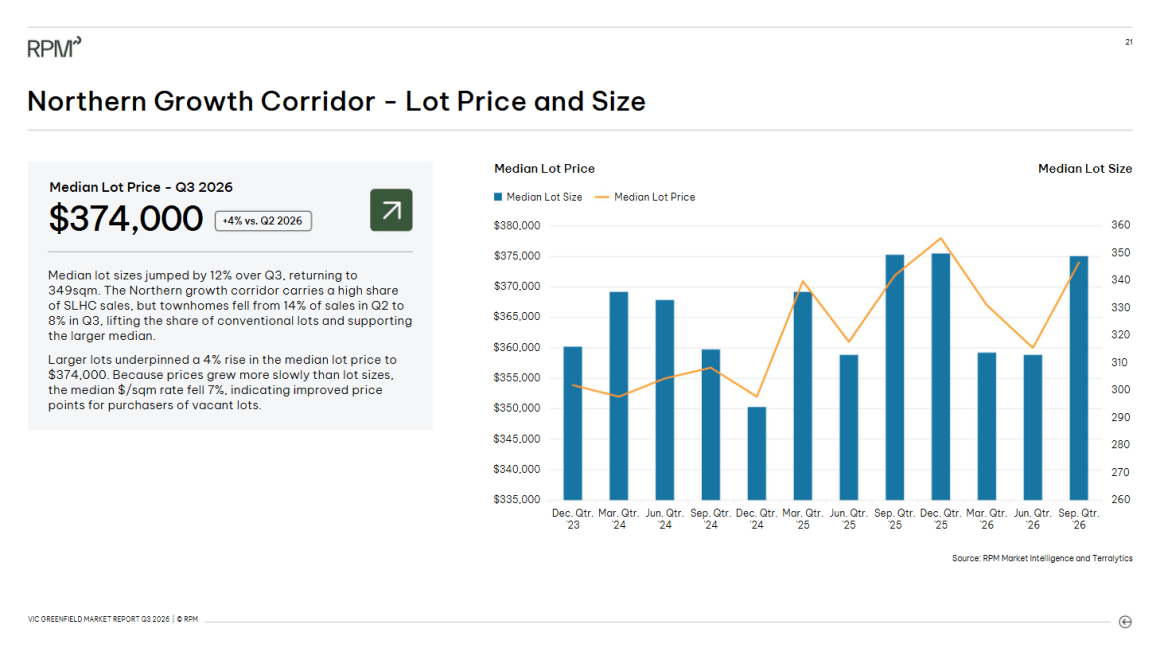
The median reached $374,000 during Q3, compared with $380,000 in the west and $452,000 in the south-east.
The northern corridor recorded 839 lot sales during the quarter, down 32 per cent from Q2.
However, the market has continued to perform relatively well when measured by the time taken to sell available lots.
Average trading periods were around four and a half months, making it the fastest-moving metropolitan growth corridor.
RPM attributed part of that resilience to a greater variety of housing options, including smaller lots and products delivered under Victoria’s Small Lot Housing Code.
Non-titled lots accounted for 66 per cent of sales during the quarter, while Small Lot Housing Code products represented 31 per cent.
The corridor’s median lot size increased to 349 sqm, with the median price rising four per cent.
Importantly, the increase in lot sizes was greater than the increase in prices, resulting in a seven per cent reduction in the median price per square metre.
For buyers, that suggests some improvement in the amount of land available for their money, even though the headline median price increased.
Suburb-level pricing also varies considerably.
RPM recorded a price of approximately $332,000 for a 350 sqm lot in Wallan, $346,000 in Beveridge, $378,000 in Donnybrook and $388,000 in Kalkallo.
Closer to established amenities, comparable lots were priced at $443,000 in Wollert and $478,000 in Craigieburn.
The figures highlight the trade-off between location, existing infrastructure and affordability for buyers considering Melbourne’s northern growth areas.
Melbourne’s south-east: Higher prices, but incentives remain available
Melbourne’s south-east remains the most expensive metropolitan growth corridor, with a median lot price of $452,000.
The median increased six per cent during Q3, reaching a new record despite sales falling 38 per cent to 622 lots.
While that may appear to leave fewer opportunities for buyers, RPM’s research suggests the market is more nuanced.
The report identified rebates and incentives at larger estates in Clyde North, Clyde and East Pakenham, where much of the corridor’s sales activity is concentrated.
The median lot size remained unchanged at 350 sqm, suggesting the quarterly price increase was not driven by buyers purchasing larger blocks.
Instead, RPM suggested the purchasers who remained active were generally less constrained by borrowing capacity, including older first-home buyers and upgraders.
Interestingly, the average time taken to sell lots fell to 142 days, the fastest result in three years.
That indicates the south-east remains a relatively active market among buyers who can afford its higher entry prices.
For buyers considering suburbs such as Clyde, Clyde North, Officer and Pakenham, the opportunity may be less about securing a significantly cheaper lot and more about comparing developer incentives, available titled stock and the overall cost of a house-and-land package.
RPM’s research found a 350 sqm lot cost approximately $414,000 in Pakenham, $433,000 in Clyde, $455,000 in Clyde North and $488,000 in Officer.
Ballarat: Victoria’s most affordable major land market
For buyers willing to look beyond metropolitan Melbourne, Ballarat continues to offer some of the most affordable land prices among Victoria’s major growth markets.
The regional city’s median lot price reached $290,000 in Q3, up 4.3 per cent from the previous quarter.
That is $103,000 below Melbourne’s overall median land price, despite Ballarat’s typical lot being larger at 447 sqm compared with Melbourne’s 350 sqm.
Sales fell 37 per cent during the quarter to 181 lots, although Ballarat was the only region in RPM’s report to record annual sales growth.
Transactions were 13 per cent higher than the same period in 2025.
Developers also responded to softer quarterly demand by halving new lot releases to 92, helping the market work through stock released earlier in the year.
RPM noted that Ballarat’s median land price remains below the levels recorded in early 2024, when prices exceeded $300,000.
For first-home buyers and families prioritising a larger block and a lower total purchase price, Ballarat’s relative affordability remains one of its strongest attractions.
However, buyers should also factor in employment, commuting requirements, local amenities and construction costs when comparing regional locations with metropolitan alternatives.
Drouin and Warragul: Could more land supply create better buying opportunities?
Drouin and Warragul may be among the most interesting markets to watch heading into 2027.
The corridor recorded 113 lot sales during Q3, down 20 per cent from the previous quarter.
That was the smallest quarterly decline of any region in RPM’s report.
However, developers released a record 188 new lots during the same period, meaning new supply exceeded sales by 75 lots.
It was the second consecutive quarter in which releases outpaced demand.
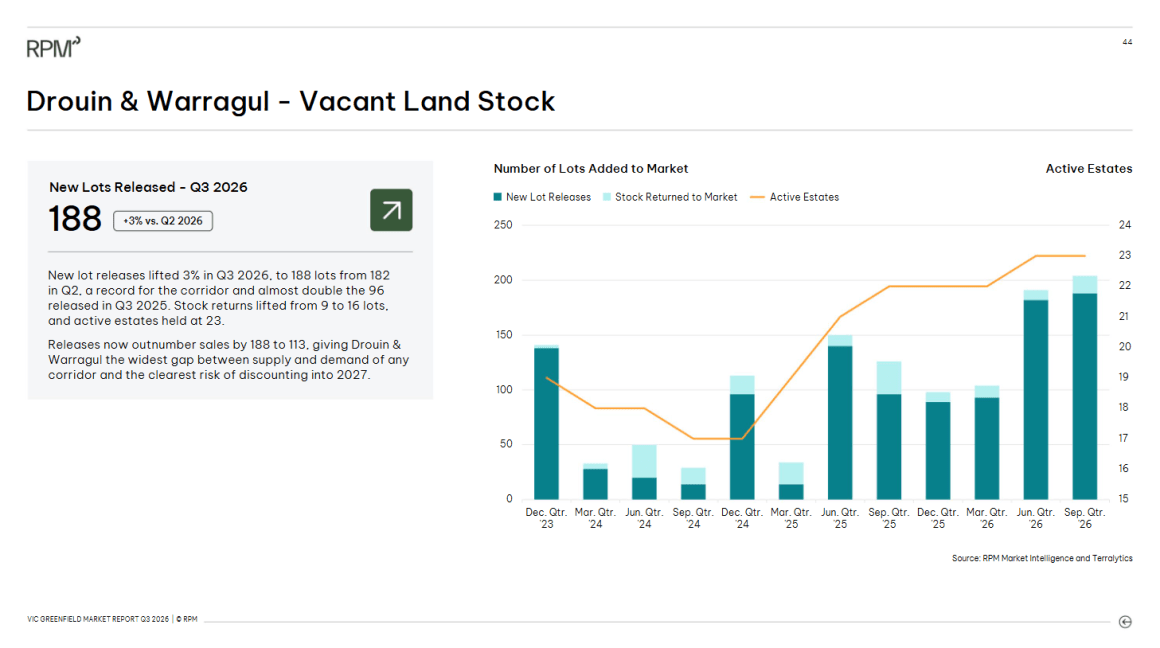
RPM identified the corridor as carrying the clearest risk of discounting into 2027, particularly if developers continue releasing land faster than buyers purchase it.
The median lot price remained relatively stable at $318,500, up just 0.8 per cent over the quarter.
The typical lot size was 489 sqm, considerably larger than the 350 sqm median across Melbourne.
For buyers looking around Warragul and Drouin, the increasing supply of available land could provide more choice and potentially greater negotiating power.
However, any future discounts will depend on individual estates, available stock and how developers respond to changing demand.
Geelong: Larger lots, but prices now rival Melbourne
Greater Geelong’s land market has become increasingly comparable with Melbourne on price.
The region recorded a median lot price of $395,900 during Q3, slightly above Melbourne’s $393,000.
However, Geelong’s median lot size was 400 sqm, compared with Melbourne’s 350 sqm.
Sales fell 47 per cent over the quarter to 339 lots, reversing the increase recorded during Q2.
Despite the decline, land prices remained relatively stable, falling just 0.3 per cent over the quarter.
RPM found that developers responded quickly to softer conditions, reducing new lot releases by 50 per cent to 208.
The reduction in supply has helped the market avoid the more pronounced imbalance emerging in Drouin and Warragul.
Armstrong Creek continued to attract buyers seeking access to established amenities, while Lara remained an important market for affordability-focused purchasers.
For buyers considering Geelong, the opportunity may lie in finding larger lots at a comparable price to Melbourne, rather than expecting significant reductions in advertised prices.
Bendigo and Macedon: More regional options for buyers
Bendigo remains one of the more affordable markets covered by RPM, with a median land price of $295,000.
The median lot size increased to 560 sqm during Q3, providing considerably more land than the typical metropolitan Melbourne purchase.
However, Bendigo recorded the largest quarterly sales decline of any region, with transactions falling 52 per cent to just 51 lots.
Developers responded by reducing new releases to 30 lots, limiting the risk of a significant oversupply.
Further south, the Macedon and Mitchell corridor recorded a median lot price of $398,000, following a 24.4 per cent quarterly increase.
RPM cautioned that the significant price movement reflected a relatively small sales market, with just 69 transactions during the quarter.
The corridor’s median lot size was 576 sqm, making it the largest of the eight regions covered.
For buyers considering locations such as Wallan and Kilmore, the appeal remains the opportunity to secure larger blocks and a regional lifestyle while retaining connections to Melbourne.
Are buyers actually getting better deals on land?
One of the most important findings in RPM’s report is that rising median land prices do not necessarily mean buyers are paying more for comparable lots.
Across Melbourne, lots priced below $350,000 accounted for just 31 per cent of sales in Q3, compared with 48 per cent two years earlier.
At the same time, the proportion of lots selling above $425,000 increased to 35 per cent.
RPM suggested that first-home buyers and other price-sensitive purchasers were retreating from the market faster than buyers with greater borrowing capacity.
That change in the types of lots being purchased has contributed to higher median prices, even as overall sales volumes decline.
The report also highlighted the importance of developer rebates and incentives, particularly on titled lots.
For buyers, this means advertised land prices may not tell the whole story.
A developer offering a rebate, a reduced deposit requirement or other purchasing incentives may provide better overall value than another estate advertising a lower headline price.
Buyers should compare the final effective land price, any conditions attached to incentives, expected settlement dates and the total cost of building before committing to a purchase.
What are buyers budgeting for new homes in Victoria?
RPM’s survey of approximately 228 greenfield buyers during Q3 provides further insight into the budgets and preferences shaping the market.
First-home buyers accounted for 61 per cent of surveyed owner-occupier buyers, highlighting their continued importance to the new-home sector.
Among all surveyed purchasers, 60 per cent were buying vacant land, while 30 per cent were purchasing house-and-land packages and 10 per cent were buying townhomes.
The most common home-and-land budget was between $600,000 and $650,000, nominated by 15 per cent of respondents.
Another 14 per cent had budgets between $650,000 and $700,000, while 13 per cent were looking between $700,000 and $750,000.
The findings suggest affordability remains a major consideration, particularly when buyers factor in the cost of construction on top of the land purchase.
They also highlight why comparing complete house-and-land packages can be more useful than looking at vacant land prices in isolation.
Is now a good time to buy land in Victoria?
While there is no single answer for every buyer or location, RPM’s latest research suggests conditions are becoming more favourable for purchasers in some parts of Victoria.
Melbourne’s west offers longer selling periods and increased stock returns, potentially providing more opportunities to negotiate.
The northern corridor remains the most affordable metropolitan growth market, while Ballarat and Bendigo offer larger blocks at lower median prices.
Drouin and Warragul are also worth watching, with new land releases now exceeding sales and increasing the potential for developer incentives.
However, the report does not suggest prices are falling across the board.
Median prices increased in seven of the eight regions covered during Q3, with Greater Geelong the only market to record a slight decline.
The opportunity for buyers is therefore less about waiting for a widespread fall in land prices and more about understanding where competition has eased, where supply is increasing and which developers may be prepared to negotiate.
With the market entering 2027 after a sustained period of higher interest rates, buyers who have their finance organised and are ready to build may be well placed to take advantage of changing conditions.
For those planning a new home, comparing available land estates, house-and-land packages and developer incentives across multiple locations remains one of the best ways to identify value.
Source: RPM Group’s Victorian Greenfield Market Report, Q3 2026, prepared by RPM Market Intelligence and Terralytics. Market figures reflect the September quarter of 2026.

Joel Robinson
Joel Robinson is the Editor in Chief at iBuildNew, where he leads the editorial team and oversees the country's most comprehensive news coverage dedicated to the new home building industry. With more than a decade of experience in residential real estate journalism, Joel brings deep insight into Australia's evolving home building and construction landscape.